
Manufacturing the Muslim Menace - Again
We cannot ignore this. It is time to Take America Back Again #TABA

In the United States of America, a nation of 340 million people and a Constitution that has endured for nearly two and a half centuries, a sitting member of Congress has chosen to manufacture a crisis and thereby denigrate Muslims.
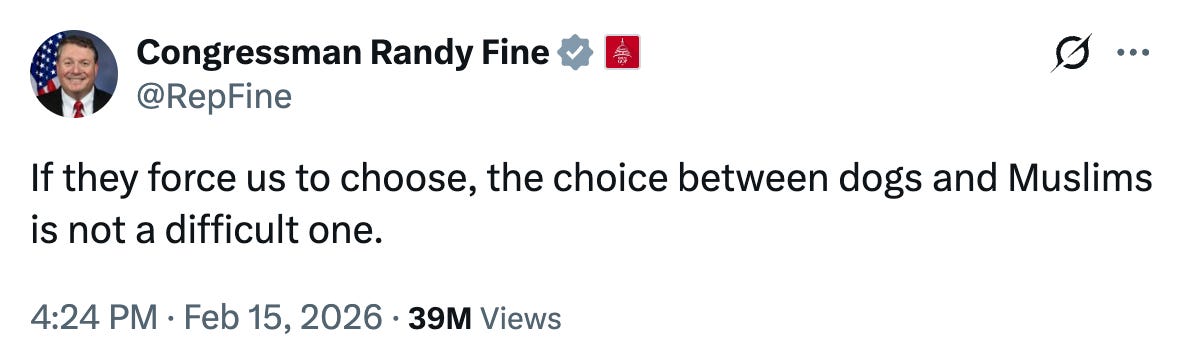
It would be farcical if it were not familiar.
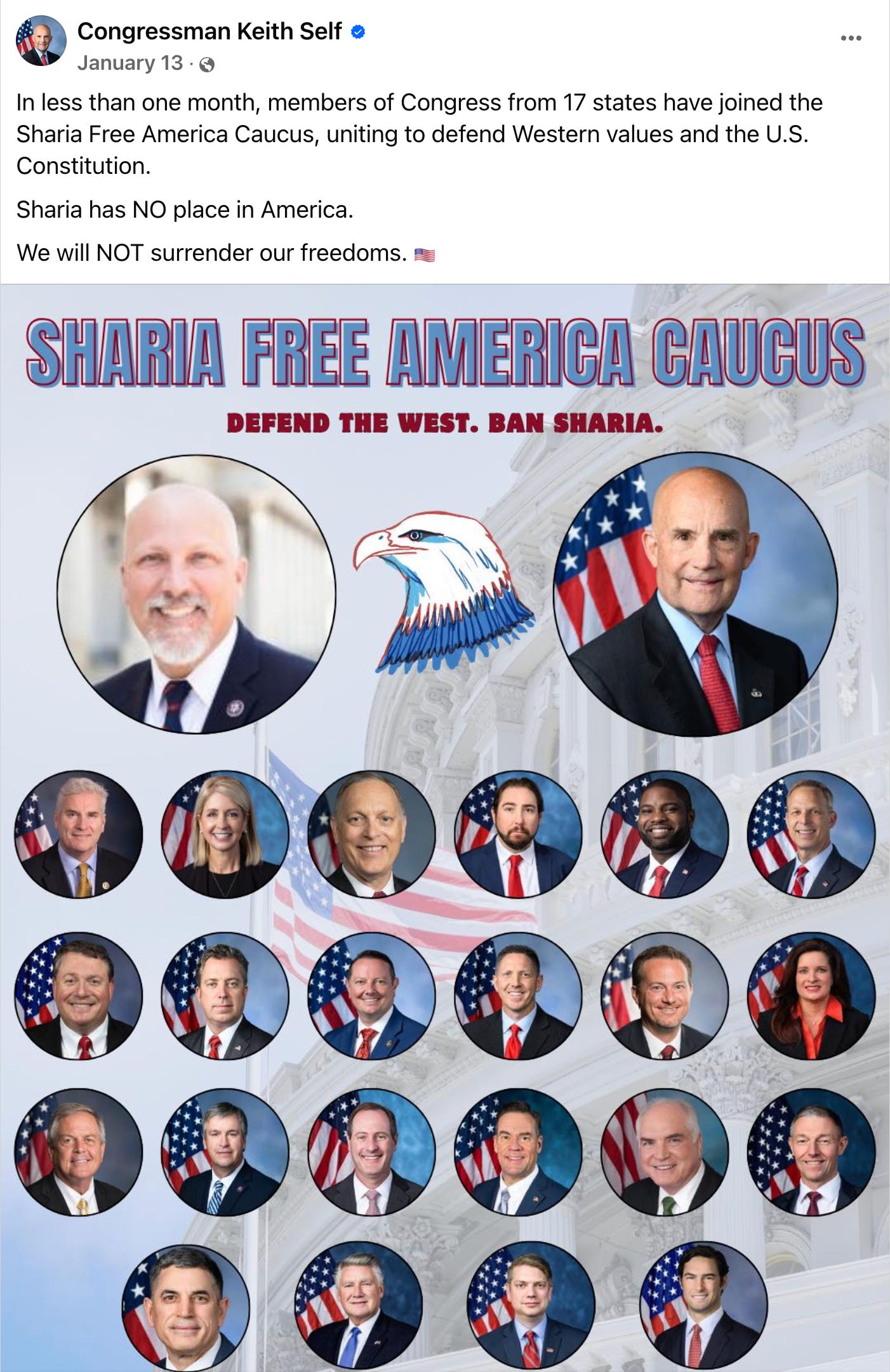
Representative Randy Fine made headlines stoking hatred and suspicion toward Muslims under the guise of a cultural concern. In Congress, a so-called “Sharia Free America Caucus” warns of the alleged creeping influence of Islamic law in American courts - a dreamed-up crisis that does not exist. At the state level, legislators periodically revive “anti-Sharia” bills in jurisdictions where there is no effort to promote “Sharia” in the system, and certainly no evidence of a threatened Islamic takeover.
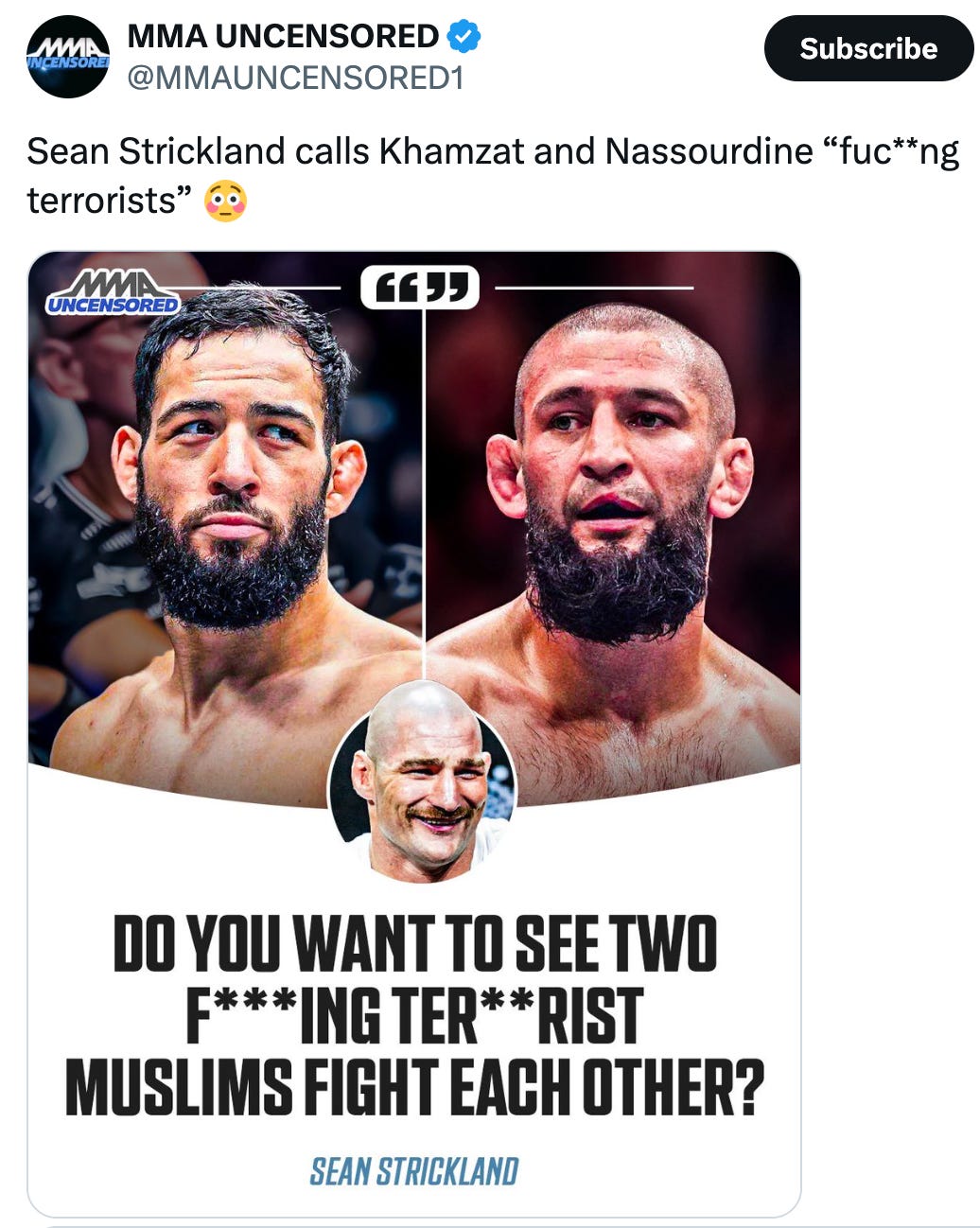
Meanwhile, in a very different arena, UFC fighter Sean Strickland recently used his public platform to refer to Muslim fighters, many of whom hail from Dagestan and Chechnya, as “Muslim terrorists.” The comment was grossly inflammatory, wholly without basis, and appears to be intended to brand all Muslims as terrorists.
These are not isolated incidents. These are part of a pattern: the resurrection of the Muslim as a perpetual civilizational threat. Do not look away. Do not ignore it.
I came to America in 1972 as a little boy, and I have seen this pattern before. I can speak to this deliberate effort to demonize Muslims because I have lived through it before. In 1979, when Iranian students took Americans hostage in Tehran, we felt the brunt of it in suburban Chicago. Grown men and women called me a “raghead” and a “sand n-word” as I walked to school. I was ten years old.
After September 11th, suspicion fell broadly and indiscriminately. Muslim families found themselves explaining their patriotism to neighbors, classmates, and coworkers. Mosques were surveilled. Ordinary religious practices were treated as evidence of extremism. Over time, the fever cooled, but the threat never went away.
In 2016, there was the call for a “Muslim Ban,” and my own young children came home asking me if we were going to be kicked out of America. That’s what a few of their classmates told them. They were less than 10 years old.
What concerns me now is not merely the resurgence of anti-Muslim rhetoric, but the ease with which it is deployed. It is so casual, opportunistic, and with little political cost.
Let me be clear: there is no creeping Sharia crisis in America. There is no secret cabal to substitute “Sharia Courts” with our secular judicial system. No one is trying to rewrite the U.S. Constitution to create an “Islamic state.” Muslims comprise a tiny minority of the American population, diverse in background, theology, and political outlook. Many are immigrants who left their countries to avail themselves of the freedoms afforded in America.
So why the constant alarm?
Simply stated, we Muslims make useful villains.
In politics, an internal “other” is powerful currency. It simplifies complex anxieties in a single, recognizable symbol. It allows a movement to cast itself as the protector of a threatened civilization. And it rallies a base that responds viscerally to narratives of cultural siege.
When a public figure like Sean Strickland labels Muslim athletes “terrorists,” he is not offering geopolitical analysis. He is signaling his membership in a tribe. When legislators warn of Sharia infiltration without evidence, they are not drafting serious policy. They are pandering to their tribe.
I understand it even as I disagree with it. Outrage is a business model. Cultural fear is a brand strategy.
But there is a deeper issue at stake.
Listen carefully to the rhetoric emerging from Christian Nationalism. It is not merely pride in religious heritage. It is the assertion that America was founded as a Christian nation, Christianity is under assault, and that it must be defended. Listen even more carefully, and you will hear this message: there is an insistence that Christianity should shape public education in explicit and binding ways. The argument is that the separation of church and state is either a myth or a mistake. It is also the romanticizing of a hyper-masculine order in which men are guardians of faith and women are encouraged (and sometimes pressured) into narrowly defined domestic roles, the so-called “trad wife” ideal.
This is not traditional conservatism. It is not simply robust religious expression. It is the language of religious supremacy. There is an irony in all of this that mainstream America should not ignore. The same voices that sound the alarm about the threat of a theocratic Islamic state often advocate for a fusion of religion and state power that mirrors the structure - if not the theology - of the systems they condemn.
When religious identity is fused with state authority…
When law is subordinated to a singular interpretation of divine will…
When women’s autonomy is framed as a sign of civilizational decay…
When minorities are told they may remain, but only on subordinate terms…
We are no longer debating school curricula or tax policies. No, we are talking about the architecture of theocracy.
I reject theocracy in all its forms. I would not want to live under the Taliban’s interpretation of Islam. Nor do I want to live under a Christian Nationalist reinterpretation of the American Constitution.
As a Muslim, my faith is deeply personal and spiritually binding. As an American and as an administrative law judge, my allegiance to constitutional pluralism is non-negotiable. The genius of this republic is not that it privileges one faith over another. It is that it protects the freedom of all the people.
Mainstream Americans should understand this: anti-Muslim rhetoric does not remain contained to Muslims. Movements that normalize the fabrication of internal enemies do not stop once one minority has been demonized and oppressed. The machinery of suspicion, once built, is adaptable.
The sentiments of Lutheran Pastor Martin Niemoller, expressed in speeches during the rise of Hitler in Nazi Germany, should resonate deeply for Americans today. His famous quote begins with “First they came for the socialists, and I did not speak out… .” Today, it is Muslims based on the fabricated “creeping Sharia” threat. Tomorrow, it may expand to things the Christian Nationalists deem “anti-Christian bias.” Once the machinery of manufactured suspicion is fully operational, journalists, academics, or judges accused of undermining the nation become easier targets. Where does it stop?
A constitutional democracy cannot survive selective loyalty. It cannot endure if we cheer when the rights of a small minority are treated as expendable because we assume we will never be the target. The test of a mature constitutional democracy is not how confidently it asserts majority identity. The true test is in how firmly it protects minorities when doing so is politically inconvenient.
Muslims, as a tiny minority in the United States, cannot correct this dangerous slide into oppression alone. Nor should we have to. The defense of pluralism is not a sectarian project. It is a civic one. If mainstream America shrugs at the normalization of anti-Muslim bigotry because it feels distant or abstract, it risks missing the larger transformation taking place in plain sight.
The real crisis in America is not Sharia. It is the steady erosion of the norm that no religion - Christianity, Islam, Judaism, Hinduism, or any other - is entitled to supremacy under our Constitution.
We should be very cautious about mocking distant theocracies while drifting toward our own version of religious nationalism at home. History teaches that societies like ours rarely collapse overnight. They erode when fear becomes fashionable and when scapegoating becomes a strategy.
The question before us is not whether Muslims are compatible with America. The question is whether America will remain true to its own ideals.
#TABA